Generative AI Course — From Python to Production GenAI

5 Months Featured Career track Architect level

A 6-month live online Generative AI course that takes you from Python and machine learning foundations to building and deploying real LLM, RAG, multimodal and agentic AI systems.

Program fee

64,999

One-time payment

The fee is ₹64,999

fee is ₹64,999

Generative AI Course Details

A quick snapshot of the format, duration, fee, core skills, projects, certificate and support you get when you join the program.

What Is the Generative AI Course at AI Career Academy?

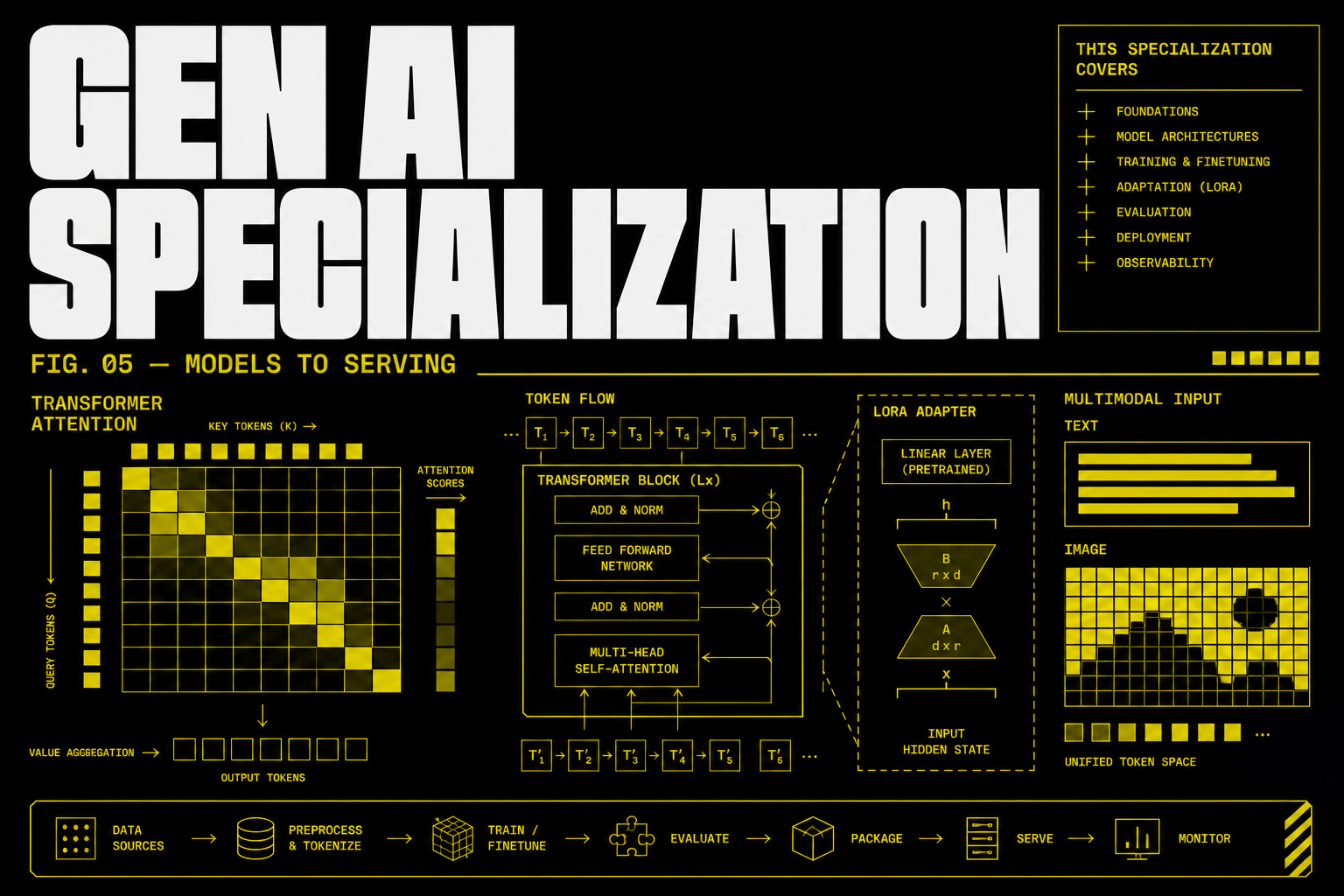
It’s a 6-month live online program that takes you from machine learning and deep learning foundations all the way to production Generative AI. You learn transformers, LLMs, RAG, fine-tuning with LoRA and QLoRA, multimodal AI and AI agents — and you build real projects at every stage. You finish with a course completion certificate, placement support and a portfolio you can actually show in interviews. The fee is ₹64,999.

What Is Generative AI?

Generative AI is a category of artificial intelligence that creates new text, images, code, audio, and video by learning patterns from large datasets. Unlike traditional ML that classifies or predicts, generative models produce original outputs. The core architectures powering this field today are: 0 1 Large Language Models GPT, Claude, Gemini, Llama 4, DeepSeek, Qwen3 0 2 Diffusion Models FLUX.1, Stable Diffusion 3.5, Sora-class video 0 3 Vision-Language Models Qwen3-VL, Llama Vision, InternVL, CLIP 0 4 Code Generation Qwen3-Coder, DeepSeek-Coder, StarCoder2

AI Foundations & Model Evaluation Lab

Build a practical ML workflow with data preparation, model training, evaluation metrics and experiment comparison so you understand how AI systems are measured before moving into GenAI.

Deep Learning & Transformer Workflow

Work with neural networks, CNN/RNN concepts and transformer-based architectures to understand how modern AI models learn from text, images and sequences.

RAG Knowledge System

Build a retrieval-augmented generation system with document ingestion, chunking, embeddings, vector search, reranking, source citations and grounded LLM responses.

Fine-Tuned LLM Assistant

Adapt an open-source language model using LoRA / QLoRA concepts, evaluate outputs on custom tasks and understand when fine-tuning is better than prompting.

Multimodal AI System

Build an AI system that works with text, image or document inputs using vision-language models and multimodal inference workflows.

Production Agentic AI System

Build a production-style GenAI system with agents, tool use, RAG or memory support, API serving, logging, evaluation checkpoints and a demo-ready workflow.

Who Is This Course For?

It’s built for developers, ML learners, freshers and working professionals who want a clear, structured path into LLMs, RAG, fine-tuning, multimodal AI, agents and production serving.

Software Developers

Build production-ready GenAI applications on top of your coding background. Move from backend and product code into LLM apps, RAG systems, and AI APIs Learn deployment-ready workflows with serving, monitoring, and integration patterns Build portfolio projects that show applied Generative AI engineering skills

ML / AI Learners

Extend ML and deep learning fundamentals into modern Generative AI systems. Connect neural networks, transformers, ViTs, VLMs, and multimodal workflows Work through RAG, fine-tuning, evaluation, quantization, and deployment Strengthen applied model-building and system design depth for real projects

Freshers & Career Switchers

Follow a structured path from foundations into deployable GenAI projects. Start with Python, ML, and deep learning fundamentals before advanced GenAI topics Build guided projects that make your learning visible in a portfolio Get support on project direction, interview preparation, and career transition planning

Working Professionals Moving into GenAI

Upskill without losing the technical depth needed for real AI work. Use live online sessions and recordings to learn alongside your existing role Focus on practical LLM, RAG, multimodal, and model serving workflows Turn current software or ML experience into production Generative AI capability

Prerequisites

Basic Python is helpful, but you do not need prior LLM or deep learning experience to start. The course begins with ML and deep learning fundamentals before moving into advanced Generative AI systems. Helpful to have Comfort with Python basics such as functions, loops, and simple object-oriented code Familiarity with core ML ideas like training, validation, and evaluation Willingness to work on guided projects and hands-on assignments You will build up during the course Neural networks, CNNs, RNNs, transformers, and modern LLM workflows RAG systems, fine-tuning, multimodal AI, agents, quantization, and serving Portfolio-ready projects with deployment and interview discussion value

AI Engineering Skills You’ll Gain

By the end you’ve built the practical skill set hiring teams expect from an AI or Generative AI Engineer — not just theory, but the ability to build, fine-tune, ground and ship real AI systems. Looking for an AI Engineering course? “AI Engineering” is defined more by job skills than by a single syllabus — building, fine-tuning, retrieving, serving and evaluating AI systems. This Generative AI course covers that full skill set end to end, so it doubles as a practical AI Engineering path. If your goal is mainly to build and ship AI applications, the AI Developer Course is the application-focused companion. 1 ML Foundations Build the mathematical and machine learning base needed for applied Generative AI work. 2 Neural Networks, CNNs and RNNs Understand the deep learning building blocks that lead into modern transformer systems. 3 Transformers and LLMs Learn attention, tokenization, prompting, and model behavior across modern language models. 4 Vision Transformers and VLMs Work with ViTs, VLMs, and multimodal pipelines that combine text and visual understanding. 5 RAG System Design Build retrieval pipelines with chunking, embedding, filtering, ranking, and grounded responses. 6 Agent Workflows Create tool-using agent systems that can reason, call APIs, and orchestrate multi-step tasks. 7 Fine-Tuning Customize models with LoRA, QLoRA, and related techniques for domain-specific use cases. 8 Quantization Reduce inference cost and improve deployment efficiency with practical optimization methods. 9 Model Serving Serve production-ready models through APIs with scalable inference patterns and deployment workflows. 10 Evaluation and Guardrails Measure reliability, quality, and safety using structured evaluation and monitoring workflows. 11 Multimodal Applications Ship applications that combine text, image, and speech inputs in one AI product workflow. 12 Deployment Readiness Connect models, serving, infrastructure, and product-facing APIs into deployable systems.

Looking for an AI Engineering course?

“AI Engineering” is defined more by job skills than by a single syllabus — building, fine-tuning, retrieving, serving and evaluating AI systems. This Generative AI course covers that full skill set end to end, so it doubles as a practical AI Engineering path. If your goal is mainly to build and ship AI applications, the AI Developer Course is the application-focused companion.

ML Foundations

Build the mathematical and machine learning base needed for applied Generative AI work.

Neural Networks, CNNs and RNNs

Understand the deep learning building blocks that lead into modern transformer systems.

Transformers and LLMs

Learn attention, tokenization, prompting, and model behavior across modern language models.

Course Curriculum

Model foundations
Module 1: LLM architectures
  • Transformers and attention
  • Context windows
  • Tokenization
Module 2: Multimodal systems
  • Vision-Language and Multimodal Models
  • ViTs and VLMs
  • Multimodal workflows
Applied GenAI
Module 3: RAG design
  • RAG Design Patterns
  • Retrieval evaluation
  • Grounding
Module 4: Fine-tuning
  • Fine-tuning and PEFT
  • Quantization
  • Preference alignment
Deployment
Module 5: Agentic deployment
  • Serving and monitoring
  • Cost controls
  • Agentic Deployment

Frequently asked questions

What Is the Generative AI Course at AI Career Academy?

It’s a 6-month live online program that takes you from machine learning and deep learning foundations all the way to production Generative AI. You learn transformers, LLMs, RAG, fine-tuning with LoRA and QLoRA, multimodal AI and AI agents — and you build real projects at every stage. You finish with a course completion certificate, placement support and a portfolio you can actually show in interviews. The fee is ₹64,999.

What Is Generative AI?

Generative AI is a category of artificial intelligence that creates new text, images, code, audio, and video by learning patterns from large datasets. Unlike traditional ML that classifies or predicts, generative models produce original outputs. The core architectures powering this field today are: 0 1 Large Language Models GPT, Claude, Gemini, Llama 4, DeepSeek, Qwen3 0 2 Diffusion Models FLUX.1, Stable Diffusion 3.5, Sora-class video 0 3 Vision-Language Models Qwen3-VL, Llama Vision, InternVL, CLIP 0 4 Code Generation Qwen3-Coder, DeepSeek-Coder, StarCoder2

Who Is This Course For?

It’s built for developers, ML learners, freshers and working professionals who want a clear, structured path into LLMs, RAG, fine-tuning, multimodal AI, agents and production serving.

Looking for an AI Engineering course?

“AI Engineering” is defined more by job skills than by a single syllabus — building, fine-tuning, retrieving, serving and evaluating AI systems. This Generative AI course covers that full skill set end to end, so it doubles as a practical AI Engineering path. If your goal is mainly to build and ship AI applications, the AI Developer Course is the application-focused companion.

How You’ll Fine-Tune, Align & Serve Models

Once you’ve picked your models, the real work is making them accurate, controllable, fast and production-ready. You move through four technique areas — adapting models, aligning them, grounding them with retrieval, and optimising them for serving. Parameter-Efficient Fine-Tuning LoRA · QLoRA · PEFT · DAPT · SFT What: Inject low-rank adapters into target layers instead of retraining the entire model. Why: Fine-tune billion-parameter models on consumer GPUs with rapid iteration and minimal compute. Alignment & Reasoning RL DPO · GRPO · RLVR · KTO · RLHF (PPO) · RLAIF What: Steer behavior and reasoning toward preferred, verifiable outputs using preference pairs and reward signals — the same methods behind DeepSeek-R1, Qwen and Kimi. Why: Safer, more controllable and better-reasoning models —

What Jobs Can This Course Prepare You For?

This course is designed to prepare you for roles like GenAI Engineer, AI Engineer, LLM Engineer, AI Application Engineer and Multimodal AI Engineer. Each one maps to a cluster of skills you practise during the program, so you can see exactly where your learning leads.

Ready to start?

Talk to an advisor about this program — 15 minutes, no sales pitch.

Career call WhatsApp